
THE BOOK
A ONE-WAY TICKET TO THE REVOLUTION
A Memoir of Identity and Resistance
during the Lithuanian Revolution
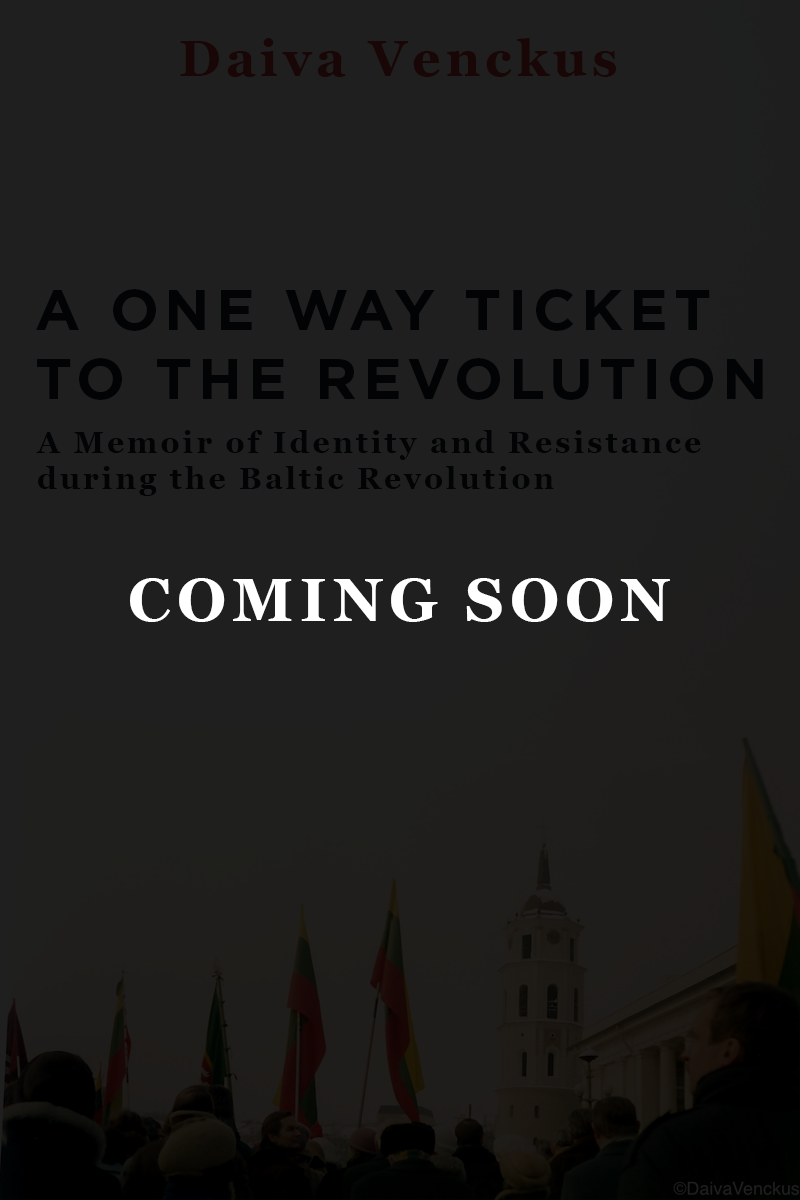
Status: Completed manuscript (99,000 words)
Genre: Memoir-Plus
I am currently seeking literary representation.
As Lithuania fought for independence in 1991, I realized the stakes were deeply personal.
If the Kremlin erased Lithuania from history, my heritage—and my own existence—would be negated.
I had no choice but to leave the safety of my life in America for Soviet-occupied Lithuania and join the independence cause.
A ONE-WAY TICKET TO THE REVOLUTION is the true story about discovering heritage, resistance, and the unbreakable will of a people. As the American-born daughter of Lithuanian WWII refugees, I grew up caught between two worlds. The duty to preserve Lithuanian culture shaped my upbringing, but I longed to be more American in a society where I felt like an outsider. The Iron Curtain, separating me from Soviet-occupied Lithuania, fractured my sense of self.
In 1989, a soul-searching trip to Soviet-occupied Lithuania allowed me to walk in my grandparents’ footsteps and reconnect with my heritage. Yet, my identity crisis remained. In 1991, I returned to Lithuania, arriving the day after Soviet tanks killed protesters and seized the national TV tower. Answering a call for English translators, I joined the resistance inside government barricades, fighting Kremlin propaganda and exposing the duplicity and the truth of Gorbachev’s Soviet Union while facing tanks, KGB sabotage, and daily shortages.
My journey to Lithuania to understand my dual identity parallels Lithuania’s fight for self-determination, exploring how personal and societal transformations intertwine.
A ONE-WAY TICKET TO THE REVOLUTION is a call to honor who you are, where you come from, and the legacy you leave behind.
WHY I WROTE A ONE-WAY TICKET TO THE REVOLUTION
I didn’t set out to write a book.
I needed therapy.
As the daughter of Lithuanian World War II refugees, I grew up with stories of escape and survival. But nothing prepared me for standing inside a parliament building as Soviet tanks advanced.
I was born in the United States. My only training for facing warfare was on a surfboard, riding the breakers of the Pacific Ocean along the Californian coastline, battling for the best spot on a gnarly wave.
Writing helped me to process what I witnessed in Lithuania. My journals captured moments, conversations, and the emotional weight of living through a revolution.
My lengthy conversations with other ex-pats and parliament co-workers highlighted the importance of validating our experiences for collective healing. I then suggested writing a book to validate their experiences, which I believed would help everyone process the events. Immediately after the events, I interviewed them, took notes, and recorded our conversations for broader perspectives. I stayed in touch to clarify details as my story evolved with new insights.
I reflected on how the duality of my Lithuanian-American childhood, family tales, and diaspora life shaped my identity and propelled me to confront Soviet tanks. This experience sparked meaningful conversations with my family, who were still, over fifty years later, grappling with their World War II scars and immigrant hardships.
What started as a journey to understand my identity transformed into a mission to seek healing—for myself, my family, my friends, all Lithuanians, and our ancestors.
When Mikhail Gorbachev, the last Soviet leader, published his memoir in 1996, he included the Kremlin’s lies used to enslave Lithuania during World War II. That Lithuania was never a sovereign nation and belonged to Russia.
I was naïve to think the Kremlin would stop threatening Lithuanian independence.
I researched obsessively, collecting and documenting sources to counter future misinformation. Eventually I enrolled in graduate school to study the causes behind the collapse of the USSR. But I found scholarly debates lacking consensus. Academics argued that key factors in the collapse included expensive militarization during the Cold War, bureaucratic complexities, deteriorating infrastructure, the war in Afghanistan, and a sluggish economy.
This “top-down” perspective overlooked a crucial element:
the experiences of everyday citizens.
During the decades of Soviet empire expansionism and rule, citizens expressed their desire to preserve their territories, history, and culture, but the Kremlin imposed brutal Sovietization and assimilation policies to maintain control. Gorbachev wrongly assumed citizens had surrendered their identities to Moscow.
The Kremlin’s extensive dismissal of efforts to uphold cultural identity was like a powder keg primed to explode, which it did in 1989, all at once.
As Lithuanians led the anti-Soviet movement to reclaim their national identity and autonomy, Gorbachev threatened them, insisting they could not survive without the Soviet Union.
The Lithuanian people’s reclaiming of their destiny—when their country, history, culture, and language were on the path to extinction—may be a valuable lesson for democracy’s future survival.
Armed only with their voices and the power of the truth, Lithuanians rose up to overthrow their far more powerful oppressor. Lithuanians made up 1.5% of the USSR population, yet they possessed the power to effect change.
Considering the terrible things happening worldwide, I have wondered since childhood what I could do to ease the suffering.
I am nobody.
I feel entirely powerless.
What can I do to make a positive difference?
Then, I witnessed how a small group of individuals, dismissed by the world as insignificant, changed the course of their history. A story I could tell with a unique perspective. A story I’ve shared through the decades in various forums and classrooms, in articles, with researchers, and in conversations.
This story encourages you to embrace your true self, honor your heritage, and value the enduring impact you make, which has the potential to transform the world.