
CLASSROOM RESOURCES
Lithuanian History Timeline
On Lithuania’s anniversary of the 1918 Declaration of Independence Act, citizens organized peaceful marches in Vilnius.
Soviet authorities attempted to thwart the demonstration and arrested 32 people.
On Estonia’s anniversary of the 1918 Declaration of Independence, 4,000 people held a rally in Tallinn.
During a live TV broadcast, Edgar Savisaar proposes creating the Estonian Popular Front (Rahvarinne).
It becomes the first legal mass socio-political movement in the Soviet Union outside the Communist Party.
Tens of thousands gathered in Tartu for the Heritage Conservation Festival. For the first time publicly since WWII, the long-banned Estonian national blue-black-white flag was openly displayed.
Moscow initially encouraged the formation of “Popular Fronts,” hoping they would serve as reformist allies against conservative Communist Party hardliners. Reformers within Gorbachev’s circle hoped to channel Sąjūdis’s energy into economic reform within the Soviet framework.
However, these movements quickly outgrew Moscow’s control.
Prominent Latvian intellectuals publicly declared that Latvia had been illegally occupied and annexed by the Soviet Union in 1940, breaking decades of state censorship.
At the Lithuanian Academy of Sciences in Vilnius, 35 prominent scholars, artists, and writers formed the Lithuanian Restructuring Movement (Sąjūdis) and elected an initiative group that included future Chairman Vytautas Landsbergis.
Over 100,000 Estonians assemble night after night at the Tallinn Song Festival Grounds, singing banned patriotic songs and openly flying the long-prohibited blue-black-white national flag.
During the rally to commemorate the 1941 Soviet deportations organized by the Lithuanian Freedom League, the pre-WWII flag of independent Lithuania was raised publicly for the first time since WWII.
Organizers from the human rights group Helsinki-86 led a procession through Riga carrying the historical maroon-white-maroon Latvian flag to the Freedom Monument.
Tens of thousands gathered in Vilnius’s main cathedral square to send off Lithuanian delegates to the 19th All-Union CPSU Conference in Moscow, demanding economic autonomy and language rights.
A Baltic Song Festival took place in Vilnius and attracted 50,000 participants. Individuals displayed the banned national flags of Lithuania, Latvia, and Estonia, and openly sang patriotic songs. They marched through the streets chanting “freedom.”
Over 100,000 people gathered to welcome returning CPSU delegates, openly displaying the yellow-green-red Lithuanian national flag and demanding the publication of the secret protocols of the 1939 Molotov-Ribbentrop Pact.
The crowd sings the pre-WWII Lithuanian national anthem for the first time since WWII.
A more radical political wing formed to demand complete independence and the removal of Soviet occupying forces.
Organized by Sąjūdis, around 250,000 people assembled in Vilnius’ Vingis Park to condemn the 1940 Soviet annexation of the Baltic states.
For the first time in Soviet public history, the secret protocols partitioning the Baltic states between Nazi Germany and the USSR were openly read, condemned, and discussed.
Around 300,000 Lithuanians, Latvians, and Estonians joined hands along the Baltic coastline in a massive environmental demonstration protesting Soviet industrial pollution.
An estimated 300,000 people (nearly a third of the entire ethnic Estonian population) filled the Tallinn Song Festival Grounds. Activist Trivimi Velliste made the first public call for full national independence.
Sąjūdis organized a human chain around the Ignalina Nuclear Power Plant (“Ring of Life”), involving tens of thousands of participants, to protest the planned expansion of a third reactor and demand safety inspections.
The Lithuanian Freedom League (Lietuvos Laisvės Lyga) held an unauthorized rally in Vilnius Cathedral Square.
Soviet special forces (OMON) violently broke up the crowd using truncheons, causing public outcry that forced the local Communist leadership to step down.
The Lithuanian tricolor was officially re-hoisted atop Gediminas Tower for the first time since the Soviet occupation. Activists from the Sąjūdis movement organized this ceremony, which drew tens of thousands of attendees.
Following summer mass rallies, the Popular Front of Latvia (Latvijas Tautas fronte) was formally established and quickly gathered over 200,000 members under the leadership of Dainis Īvāns.
Forced resignation of hardline First Secretary Ringaudas Songaila due to public backlash from the September 28 police violence; replaced by Algirdas Brazauskas, who was sanctioned by Moscow to negotiate with Sąjūdis.
Sąjūdis held its inaugural Constituent Congress in Vilnius, attended by over 1,000 delegates representing Sąjūdis groups across Lithuania.
Broadcast live on Lithuanian state radio and television, the congress officially codified Sąjūdis as a national political force, elected a 35-member Seimas Council, and declared goals of political, economic, and cultural autonomy.
Without consulting Gorbachev, Lithuanian Communist Chief Brazauskas returned the main Cathedral in Vilnius to the Catholic Church. Moscow had shut its doors after WWII. At dawn, tens of thousands of Lithuanians attended the first Mass service there since WWII.
Moscow recognizes the Catholic feast day of All Soul’s Day, and allows citizens to acknowledge the holiday publicly.
Realizing that the Baltic movements were seeking independence, the KGB and Moscow party officials organized counter-movements composed mostly of Russian-speaking factory workers and Soviet military personnel:
- Estonia: The Intermovement (Interrinne).
- Latvia: The International Front of Working People (Interfront).
- Lithuania: Jedinstvo (Unity, officially the Socialist Movement for Perestroika in Lithuania “Vienybė-Jedinstvo-Jedność”).
These groups organized counter-protests, industrial strikes, and rallies to support central Soviet authority and oppose Baltic language laws.
The Supreme Soviet of the Estonian SSR passes the Declaration of Sovereignty, asserting that Estonian laws take precedence over Soviet Union laws—a landmark constitutional event.
The Presidium of the Supreme Soviet of the USSR in Moscow officially declared it null and void on November 26. However, Moscow lacked the political leverage to enforce this decision on the ground without invoking massive military force, triggering a constitutional stalemate known as the “War of Laws.”
Under immense popular pressure led by Sąjūdis, the Supreme Council of the Lithuanian SSR officially legalized the Lithuanian tricolor flag, the historic anthem (Tautiška giesmė), and Lithuanian as the state language.
The Supreme Soviet of the USSR in Moscow formally adopted constitutional amendments that strengthened Moscow’s central authority, despite the 1.8-million-signature petition, triggering open political friction over state sovereignty.
Mikhail Gorbachev publicly criticized Baltic “separatist tendencies” and warned against undermining the legal unity of the Soviet Union, signaling the end of the Kremlin’s initial permissive attitude toward Baltic reform movements.
The Supreme Soviet of the Estonian SSR passed the Language Law, designating Estonian as the official state language and requiring public employees to demonstrate proficiency within four years.
The Russian “Jedinstvo” (working with the CPSU) organized a rally of 50,000 non-Lithuanians to protest the law making Lithuanian the official language, demanded the replacement of the Lithuanian Communist Party leadership, and urged a work stoppage to protest the decision to re-establish Lithuanian Independence Day as a republic holiday.
On the 71st anniversary of Lithuania’s 1918 Act of Independence, Sąjūdis issued a declaration formally stating that its goal was the restoration of an independent Lithuanian state, stepping past the framework of Soviet system reform.
8,000 people participate in a pacifist demonstration in Kaunas and call for a stop to the forced induction of Lithuanians into the Red Army.
Soviet Spetsnaz, airborne troops, and internal forces violently dispersed a peaceful pro-independence rally outside the Government House on Rustaveli Avenue in Tbilisi.
Troops used entrenching shovels (saperka) and toxic CS/CN gas against civilians, killing 21 people (mostly women and young girls) and injuring hundreds.
Delegates from all three popular movements gathered in Tallinn for the first Baltic Assembly, establishing joint policy goals and formally demanding the annulment of the 1939 Molotov–Ribbentrop Pact.
The Supreme Soviet of the Lithuanian SSR adopted a Declaration of State Sovereignty (by a vote of 291 to 8, with 3 abstentions), asserting that Lithuanian laws took precedence over USSR central legislation within the republic.
At the USSR Congress of People’s Deputies session in Moscow, the head of the Lithuanian Communist Party demands that the Kremlin reveal “the historic truth” about the Molotov-Ribbentrop Pact.
Yielding to pressure from Baltic representatives, Mikhail Gorbachev approved the creation of a special commission, led by Alexander Yakovlev, to investigate the secret protocols of the 1939 Molotov–Ribbentrop Pact.
USSR Leader Mikhail Gorbachev tells viewers on Moscow TV that the Baltic national drive for independence would not be tolerated.
Marking the 50th anniversary of the Molotov–Ribbentrop Pact, roughly two million people joined hands to create the Baltic Way—a continuous 675-kilometer human chain connecting Tallinn, Riga, and Vilnius to demonstrate the shared demand for independence.
Moscow condemned the protest and claimed it was organized by “extremists” discriminating against other nationalities.
The Central Committee of the CPSU issued a harsh official statement broadcast on Soviet television.
The Kremlin accused Baltic leaders of inciting “nationalist hysteria” and warned that such political movements were putting the future of their nations at risk.
Seeking to address mounting regional pressure while preserving union cohesion, the Supreme Soviet of the USSR enacted a law granting economic self-management to the three Baltic republics effective January 1, 1990.
The three republics would control their own trade, industry, and resources, and have the right to conduct their economies on a free-market basis.
The Supreme Council of the Lithuanian SSR amended Article 6 of its constitution, removing the Communist Party’s leading role and becoming the first Soviet republic to legalize a multi-party system.
Led by Algirdas Brazauskas, the Communist Party of Lithuania (LKP) held its 20th Congress and voted overwhelmingly to break away from the Communist Party of the Soviet Union (CPSU) with a vote of 855 to 150, reorganizing as an independent national party.
This creates a new schism, leaving a Communist Party in Lithuania (LCPSU) still loyal to Moscow who’ll attempt to subvert and overthrow Lithuanian independence.
Following the findings of the Yakovlev Commission, the USSR Congress of People’s Deputies formally voted to acknowledge, condemn, and invalidate the secret protocols of the Molotov–Ribbentrop Pact, declaring them null and void from the date of execution.
That the Soviet-German Pacts of 1939 violated “the sovereignty and independence of other nations and were legally untenable and invalid from the moment they were signed.”
Speaking to the Central Committee of the Soviet Union’s Communist Party, Gorbachev denounces as “illegitimate” the Lithuanian Communist Party’s decision to become autonomous, and warns that the Soviet Union would not permit “the breakup of the federal state.”
Gorbachev visits Vilnius. 250,000 Lithuanians gather for a peaceful pro-independence rally.
Gorbachev tries to persuade the Lithuanian Communist Party to return to the fold, but Brazauskas says that’s not possible.
Gorbachev announces the Kremlin has begun work on procedures for 15 republics to secede, but Lithuanians view it as a propagandistic trap.
In a vote of 228 to 4 (19 abstaining), the Lithuanian Supreme Soviet elects Lithuanian Communist Party head Algirdas Brazauskas as Chairman, seemingly endorsing his defiance of Moscow and Gorbachev.
In response to anti-Armenian pogroms and a growing anti-Soviet political takeover by the Popular Front of Azerbaijan, Gorbachev declared a state of emergency.
Over 26,000 Soviet troops, backed by tanks and armored vehicles, smashed through civilian barricades and stormed Baku.
Troops fired directly into crowds, civilian cars, and residential buildings, killing between 130 and 170 civilians and wounding over 700.
In the first multi-party elections held in Soviet Lithuania, candidates endorsed by the non-violent movement Sąjūdis-backed candidates won a decisive majority (91 of 141) in the Supreme Soviet (Supreme Council).
The newly elected Supreme Council passed the Act of the Re-Establishment of the State of Lithuania (with a vote of 124 for, 6 abstentions, and o nays), declaring full independence from the Soviet Union and electing Vytautas Landsbergis as Chairman of the Supreme Council.
Soviet Military General Varennikov proposes a plan at the Politburo meeting to squash Lithuania’s independence: claim a state of emergency, implement direct presidential rule, bring in three regiments, “isolating” the Vilnius leadership, and have a puppet group of Lithuanians “inviting” the Soviet Army according to the Prague scenario.
The Popular Front of Latvia (Latvijas Tautas fronte) won a two-thirds majority in elections for the Supreme Soviet of the Latvian SSR.
Elections were held for the official Estonian SSR Supreme Soviet, resulting in a firm majority for pro-independence forces led by the Popular Front of Estonia (Rahvarinne). Edgar Savisaar was subsequently named Prime Minister.
Gorbachev states: “Information received from the Lithuanian SSR shows volunteers are being registered in the territory of the Republic for so-called national defense organizations, with the purpose of replacing the activities of the border army and, in part, Internal Affairs affiliates.”
Gorbachev demands they stop and turn over any weapons.
In a show of force, a column of about 100 Soviet tanks and 1,500 soldiers passed by the Lithuanian Parliament building. Parliament passed an emergency resolution declaring that it would transfer all authority to its representatives in Washington, D.C., in the event that legislators were arrested or martial law was imposed.
Armed Soviet soldiers, accompanied by pro-Moscow communists, seize Lithuanian Communist (LCP) buildings in Vilnius: The Political Education Institute (Marxism-Leninism University) and the Institute for Higher Party Education. Moscow prepares strongholds for their division of the Party to work against Lithuanian independence.
Since Lithuania re-established independence, young Lithuanian men refused to serve in the Red Army where they suffered human rights abuses.
Over 850 Lithuanians left the Red Army and went into hiding. Soviet forces brutally seized Red Army deserters seeking refuge at a Red Cross hospital.
The Estonian Supreme Soviet adopted a resolution declaring the Soviet occupation of Estonia illegal and proclaimed a transitional period to restore the Republic of Estonia in full.
Soviet soldiers seize Vilnius Communist Party historical archive, General Prosecutor’s Office and printing plant where Lithuanian independence newspapers are printed. Moscow intended installing their own Prosecutor General for the “Lithuanian Socialist Republic” to create confusion and subvert Lithuania’s independence and their intentions to appoint their own independent Prosecutor General.
After Lithuania rejected his ultimatum demanding the revocation of the March 11 declaration, Mikhail Gorbachev imposed an economic blockade on Lithuania. Moscow cut off supplies of crude oil, natural gas, and vital raw materials, severely straining the Lithuanian economy for 74 days.
The Latvian Supreme Soviet adopted the declaration “On the Restoration of Independence of the Republic of Estonia and Latvia.”
Like Estonia, Latvia declared the 1940 Soviet annexation illegal and established a transitional period toward de facto independence under its 1922 Constitution.
Dainis Īvāns and Ivars Godmanis emerged as key executive leaders.
The Estonian legislature dropped the designation “Estonian SSR,” restored the official name Republic of Estonia, and re-adopted key provisions of the 1938 Constitution.
Pro-Soviet forces aligned with the Interfront movement, alongside cadets from Soviet military academies, attempted to force their way into the Supreme Council building in Riga before being turned back by police and unarmed volunteers.
Pro-Soviet loyalist groups organized by Intermovement (Interrinne) attempted to storm the Estonian Parliament building (Toompea Castle) in Tallinn. Prime Minister Savisaar broadcast a live radio plea for help, bringing thousands of Estonians to defend the government and peacefully disperse the crowd.
The parliament of the Russian Federation, led by Boris Yeltsin, formally declares its sovereignty.
Yeltsin quickly becomes an ally of the three Baltic nations, further angering Gorbachev.
Yeltsin, which declared preparations to begin bilateral state treaties. If the Russian state was to sign treaties with the Baltic nations, then it validated not only the Baltic nations’ independence, but also the Russian state’s independence from the Soviet “center.
To ease economic pressures due to Gorbachev’s blockade, Lithuanian Supreme Council adopts (69 yea, 35 nay, 2 abstentions) a Moratorium to suspend the Act of Independence only when negotiations for independence with Moscow begin.
Moscow stalled talks and eventually withdrew all-together, therefore the Moratorium never went into effect.
200 Lithuanians protest the Red Army in Lithuania at the “Northtown” barracks in Vilnius. Soviet forces turn a firehose on the protestors.
Soviet APCs chase retreating protestors, soldiers shoot their weapons in the air. 200 soldiers run into the street and beat protestors with sticks.
Announcement in the three Baltic republics of the formation of the ‘National Salvation Committee’ to restore Soviet rule. Their membership is kept secret, but it includes local hard-line Communist Party and military leadership.
Gorbachev granted new emergency powers to declare state of emergency and implement direct presidential rule.
He disbanded the presidential council (removing reformers), formed new security council composed of KGB, Ministries of Interior and Defense.
This prepares for first step of General Varennikov’s proposed plan to act against Lithuania.
Gorbachev unveiled the “New Union Treaty,” proposing some level of sovereignty for republics, but the stipulation that republics would control their own lands and resources “except those parts required to implement the union’s authority” secured Moscow’s central authoritarian hold. Balts viewed the treaty as a ploy for Moscow to assert more power over them.
USSR Defense Minister Dimitry Yazov issues a decree stating Soviet military patrols and checkpoints will be active in the Baltic republics to arrest and detain Red Army draft dodgers and those who act aggressively toward Soviet forces and any other suspicious individuals.
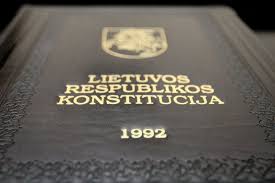
The new constitution was approved by the Supreme Council and submitted to a national referendum. The constitution was approved by 75% (by 57% of eligible voters).
After independent Lithuania established a democratic constitutional government and the office of a president, citizens elected former communist reformer leader Algirdas Brazauskas. He served one term.
(Photo: atminimas.kvb.lt)
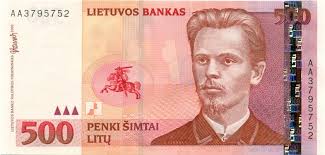
Lithuania reintroduces its pre-Soviet occupation national currency, the Litas.
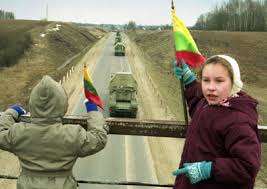
Following independence and after two years of negotiations, the final Soviet troops finally withdraw from the territory of Lithuania.
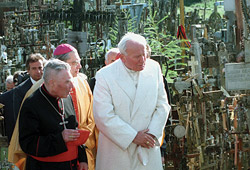
Pope John Paul II had been an active supporter of Lithuanian independence, and in his visit to Lithuania, he honored those who suffered under communist rule and provided encouragement for a brighter future.
Pope John Paul II visited the Vilnius Cathedral and the Gate of Dawn, The Hill of Crosses, The Shrine of Our Lady of Šiluva, Kaunas Cathedral Basilica, and the Trakai Church.
Valdas Adamkus was born in Lithuania but escaped during the Soviet occupation of Lithuania in WWII. As a displaced person, he emigrated to the United States, where he served in the U.S. Army and later worked at the Environmental Protection Agency. He returned to Lithuania after independence. He served two terms.
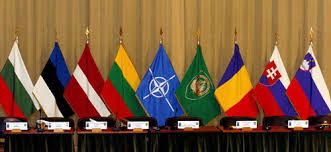
After ten years of reforms and other actions necessary for membership, Lithuania became a full member of NATO.
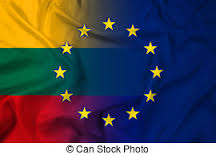
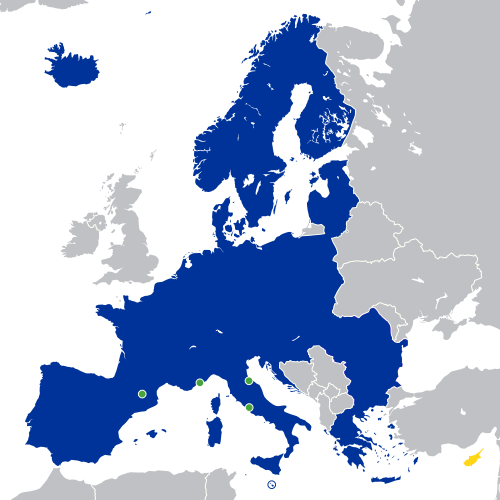
Dalia Grybauskaitė was elected to two terms, running as an independent. An economist and former Lithuanian Minister of Finance and European Commissioner for Finance Programming and Budget.
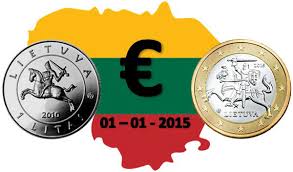
The Litas was switched to the Euro at the rate of 3.4528 to 1.
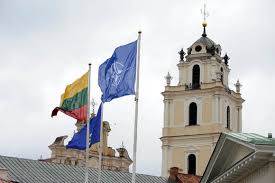
NATO Opens Permanent Military Post in Lithuania
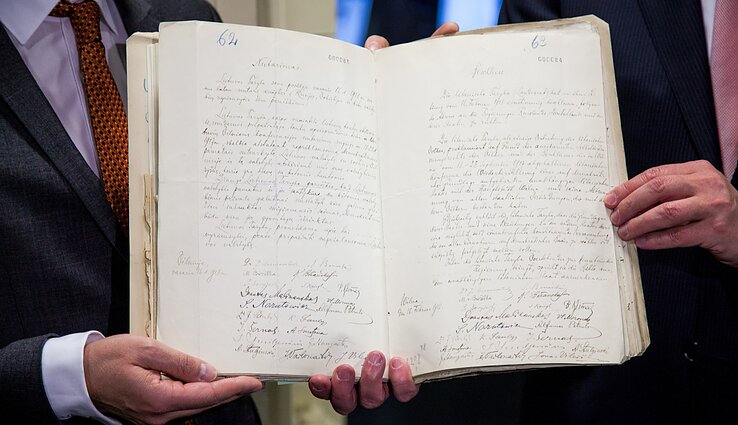
Liudas Mažylis, a political scientist at Vytautas Magnus University in Kaunas, found the original document in Germany’s State archives. He found the original alongside a German translation of the document.